
Chris and Peggy
My parents meet and marry.

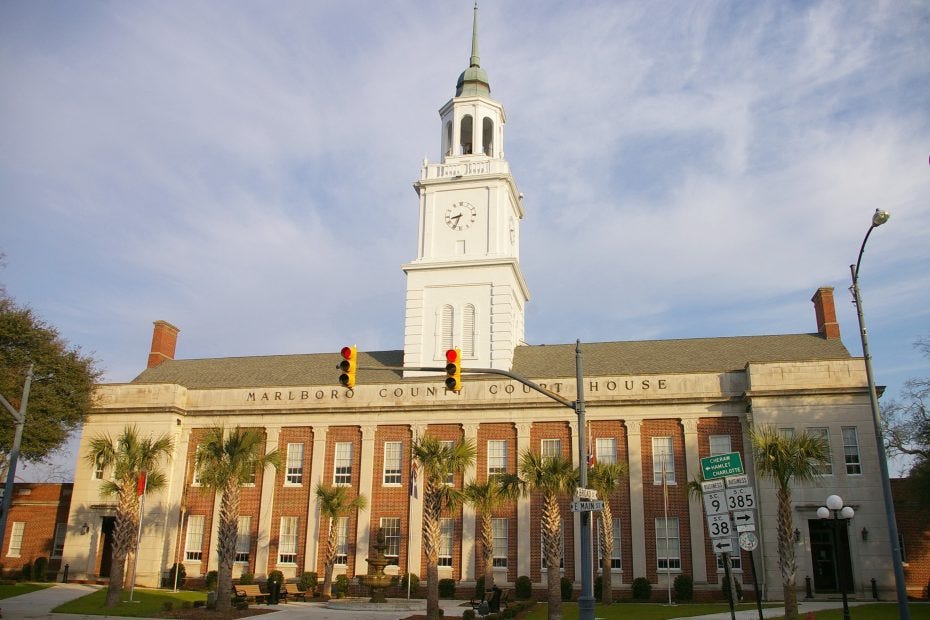
The Marlboro County Court House in Bennettsville, South Carolina, where my parents were married in May 1958.
“Happy families are all alike,” declared Leo Tolstoy in perhaps the most famous of many famous Tolstoian pronouncements. “Unhappy families are unhappy each in their own way.” The line comes from Anna Karenina, next to War and Peace his best-known novel. Taken in context, it has merit. It introduces a situation in which a husband’s infidelity has just come to light, which not only desolates the wife but throws the whole family into disarray. It conveys to each member an acute impression that “there was no sense in their living together,” that they were essentially strangers to one another. If the husband/father could hoard in secret a betrayal not just of his wife, but of everyone in it—the spousal bond is, after all, the nucleus of every family—then who could deny that everyone in the family might betray everyone else? The disturbing new truth roiled not just the wife, who was devastated; and the children, “who ran wild all over the house;” but even the five employees who constituted the household help.
I would eventually see firsthand that kind of bomb explode in my family, though not with quite that effect.
But taken in isolation, as it usually is, the pronouncement is eloquent, assured—and stupid.
Tolstoy postulates a dichotomy between “happy” and “unhappy” families. That’s farcical. All families have moments of joy; all face adversity. The question is how well a family is able to manage the challenges that life hurls at them. There are families that handle the challenges extraordinarily well and families that handle them scarcely at all, but families lie on a spectrum from the first extreme to the other. Psychologists and sociologists speak of “functional” and “dysfunctional” families. Many families have elements of both: They weather some storms well and are capsized by others. But whatever they are fated to be, all families begin the same way: two people resolved to blend their lives together.
We usually think about the start of that blending in terms of a traditional wedding: the happy groom in his rented tuxedo and the radiant bride in her fairy tale princess wedding dress. The dress especially seems always to exert a magic that makes “happily ever after” seem inevitable, not illusory. The beneficent clergyman who presides over their moment of union, be it ultimately blessed or cursed, will offer the standard cautions of worse as well as better, sickness as well as health, poverty as well as prosperity, but even Cassandra gained a better hearing from her listeners. All that matters is the ring and the kiss and the introduction of the newly minted man and wife (as it would once upon a time have been expressed) to the assemblage of delighted family and friends. And then for the couple the odd sensation of having set sail from a bustling port onto the endless open sea; and simultaneously of having returned to the harbor’s sheltered safety, the terrors of the storm-tossed waves and lashing rains behind them. Home at last.
But the couple who became my parents, 23-year-old Chris Grimsley and 22-year-old Peggy Harvin, were denied the tuxedo and the dress and the delighted dearly beloved, just as in years past and years to come they had been and would be denied so many things. Their moment of union, such as it was, consisted of a hasty nighttime drive to a drab motel outside an anonymous town they had never seen before and would never see again; a visit to the stolid county court house in the town square; their names, addresses, ages and signatures set down on the requisite form to secure a marriage license; and vows recited before a justice of the peace, all in a day’s work. No well-wishers to celebrate their union, at least not sincerely; no memento save a postcard of the motel where they spent their wedding night, and not much idea of what would happen next.
In truth, not much idea of one another, either.
My parents were married on Wednesday, May 21, 1958. They had met less than five months before, sometime in early January and somewhere on the campus of East Carolina College, one of North Carolina’s archipelago of public colleges and universities. My father was immediately smitten, and a couple of weeks into their relationship he wrote my mother a letter so drenched in affection that she kept it all her life, even after the ultimate destruction of what proved to be a difficult and often unhappy marriage.
At 9 p.m. on Saturday, January 18, 1958, my father abandoned his textbooks and in his firm, masculine hand-writing penned my mother a three-page letter. “In the cold light of day,” he began, “—this note—letter—what have you; may seem ridiculous, however, though I realize this. . . . there is, at least for the moment, the need to talk to you and since our sixth sense has not paralleled our development of writing—perhaps this page will suffice to capture this moment as it is—I know I could never tell you about it later.”
“A few moments ago I was trying to study,” my father continued. “Odd though it may seem, a little background music usually helps, but tonight all it does is bring visions of you to me—So you see it seems I can neither study when I’m with you nor when I’m without you. That probably sounds like a bad state of affairs—yet, I would not trade that ‘need for you to be near’ feeling for all the World. This is a crazy world Peg—two weeks ago I had not even heard of you—and tonight you possess my every thought—How do you explain this to anyone? How do you explain it to yourself? I do not know, and yet it is fact so I cannot deny it—even if I wanted to.”
For the next two pages, my father wrestled with a problem that most of us have faced at least once in our lives. There are those for whom every new infatuation feels like the discovery of a soulmate, who seem to be perpetually seventeen. My father was not like that. Still, it is clear from the letter that both he and my mother were already pretty far gone. “You told me a few days ago that when your parents saw us together—‘they’d know’—At the time this did not seem to be too significant—Tonight though, I know what you meant…. my parents, when I told them about you—read my thoughts like an open book. They were quite pleased at the girl who I described and they are looking forward to meeting you next week-end.”
My father understood perfectly well that saying “I love you” after just two weeks was, ordinarily at least, premature. At one point in the letter he asked my mother to recall a conversation when they first met when “we were discussing the various shades and meanings of love—At that time I told you it was unfortunate that our language did not have a word that meant—‘almost love.’” Now, however, he was disappointed that the language did not contain a word sufficient to convey what he was feeling at that moment. So for lack of anything better he was going to use the word “love,” and by way of staking a claim to it, he copied out an entire sonnet by Edna St. Vincent Millay:
Love is not all: it is not meat nor drink
Nor slumber nor a roof against the rain;
Nor yet a floating spar to men that sink
And rise and sink and rise and sink again;
Love can not fill the thickened lung with breath,
Nor clean the blood, nor set the fractured bone;
Yet many a man is making friends with death
Even as I speak, for lack of love alone.
It well may be that in a difficult hour,
Pinned down by pain and moaning for release,
Or nagged by want past resolution’s power,
I might be driven to sell your love for peace,
Or trade the memory of this night for food.
It well may be. I do not think I would.
After they were in their graves, I sometimes wise-cracked that my parents had no business sharing a taxi, much less a marriage. That was not merely cruel; it was, despite the rocks and shallows that, from the start, lurked beneath the surface of their relationship, not accurate, either.
I wonder what my father told my mother, in the glow of their relationship’s early weeks, about his childhood and adolescence. Like most of us, he would have focused on their happier aspects. So, he would have told her a lot about his friends and relatives in New Bern; and Roxy and Pop—and his new sister Debbie, for Roxy and Pop had adopted an infant girl in early 1954. (The first memory that Debbie has of my father is of his arrival at their house after receiving his discharge, still clad in his sailor’s uniform.) But how much did he tell her about Nettie and the story—to whatever extent he knew it—of how he had gone from being a Jenkins to being a Grimsley?
I also wonder what my mother told my father about her own origins. She could scarcely have avoided talking about the difficulties of her own childhood and adolescence and her fraught relationship with Tom and Margaret Ann. Those were far too prominent to overlook. But, again like most of us, she would have emphasized the happier aspects of her background, particularly all the friendships she had forged in high school and her warm, quasi-parental relationship with her younger siblings.
So, I doubt that my father had as yet received much of an education about Tom Harvin when he and my mother visited Woodland in mid-May. But that was about to change.
I am eagerly following.